Selecteer de WordPress Menu-widget en kies Hoofdmenu. Bestaande submenu’s en de taalschakelaar blijven dan gekoppeld.
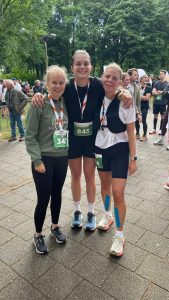
On 14 and 15 March, a special team will be at the starting line of the KPMG Lentemarathon in Amstelveen. Eight runners, spread across all distances, but with one common reason to get moving. Under the name Team Ro, they are running for Romée — to commemorate her, to tell her story, and to draw attention to the KEA foundation. A foundation that is committed to helping people who suffer from mental illness and supports them in one of the most difficult and vulnerable journeys that exist.
For her family and friends, sport was inseparable from who Romée was. That is precisely why running has now become a way to transform her legacy into something that reaches beyond their own grief.
Lentemarathon: Can you tell us who Romée was, and how Team Ro came into existence?
Anique: Romée was my friend since secondary school. We’ve known each other since our very first year. When I think of her, I think of someone who was athletic, driven, and always in motion. Running was something we often did together. It was simply part of who she was.
We lost her this past summer, after years of psychological suffering. Just one week before that, I ran my first marathon. Even then, she was still sending me messages wishing me good luck. That says everything about her. Despite everything she was going through, she remained deeply engaged with the people around her.
After she passed away, I knew I wanted to run another marathon — but this time with a different purpose. For her. Not only to remember her, but to create something meaningful out of something so painful and difficult. That’s how Team Ro was born, together with a few friends from our school days. We wanted to find a way to keep her story alive, and to make a difference for others.
Lentemarathon: Marieke, as Romée’s mother, you witnessed her journey up close. Could you share something about that?
Marieke: Romée suffered intensely from psychiatric illness for five years. She underwent an enormous number of treatments. One of those was electroconvulsive therapy — a treatment where electrical impulses are administered to the brain under anesthesia to treat severe depression. These are very heavy treatments, and in her case they had major consequences. She experienced significant memory loss.
She was an intelligent young woman. She studied medicine and had begun her clinical rotations. But because of her illness and the treatments, she gradually lost more and more of herself. Things that had once been natural — studying, working, functioning in daily life — became increasingly difficult, or even impossible.
She made multiple suicide attempts. Ultimately, she applied for euthanasia, because she experienced her suffering as unbearable and no longer saw any perspective for her future.
What many people do not realize is how complex this process is within psychiatric care. There are long waiting lists, sometimes lasting years. At the same time, it is precisely during such periods that it is crucial for someone to feel heard and understood.
Lentemarathon: You have chosen to support Stichting KEA. Why this foundation in particular?
Marieke: Stichting KEA supported Romée during a time when she often felt unheard. Through the foundation, she was connected with a buddy — someone who was there for her, who listened, and who took her seriously.
What we want to share now is that acknowledging a death wish does not mean giving up on someone. On the contrary. When someone feels heard, it can bring peace. It can create space. It can even allow someone to become open to treatment again, and to see perspective where there was none before.
That may sound contradictory, but it is deeply human. When someone feels misunderstood, it can intensify their despair. But when someone feels understood, it can become the beginning of relief.
Anique: That was also an important reason for us to support this foundation. The people who do this work are volunteers, offering their time and presence to people in their most vulnerable moments. Stichting KEA also actively supports these volunteers. You know that every donation directly contributes to real, meaningful support.
Lentemarathon: You chose this form of fundraising because sport played such an important role in Romée’s life, even during her most difficult period.
Anique: Yes. Despite everything, running remained something she could hold on to. She had signed up for a 10-kilometer race and was training seriously for it. She followed a structured training plan and truly worked toward that goal.
It gave her structure. It gave her purpose. Something to look forward to.
Even while she was admitted to a treatment facility, she kept training. She received support and encouragement from the people around her. That shows how strong her perseverance was.
On the day of that 10-kilometer race, things did not go as planned. Because of her medication, she struggled and had to stop before finishing. But even that moment says something about her. She kept trying. She kept fighting.
That perseverance is what we carry with us now. Every step we take, we also take for her.
Lentemarathon: How has Team Ro grown into what it is today?
Anique: It started with a small group of friends. But soon, more people wanted to join. We are now a team of eight runners. Everyone has chosen their own distance. Some are running the marathon, others the 10 kilometers, and some are participating in a walking distance.
We initially set a fundraising goal of €1,000. Even that felt ambitious at the time. But we reached it within two days. That was incredible.
We realized how many people were touched by her story. People shared it within their own networks, talked about it, supported us. Our goal has now been raised to €10,000. Ultimately, of course, we hope to raise as much as possible for the foundation we believe in so deeply. It shows how much impact one person can have.
Lentemarathon: Why did you choose the Lentemarathon in Amstelveen?
Anique: My first marathon was abroad. It was special, but no one could come to watch. This time, I wanted to run close to home, so that friends and family could be there.
It feels right to do this together. To carry her name — both literally and figuratively — across the finish line.
My personal goal is to finish under four hours. My previous marathon time was 4 hours and 35 minutes. But in the end, the time is not what matters most.
What matters most is why we run.
Lentemarathon: What do you hope this initiative will achieve?
Marieke: We cannot change anything for Romée anymore. But perhaps we can help create more understanding. More openness. More support for people who are going through the same struggles now.
That is what Stichting KEA is committed to. And that is what we are committed to as well.
Anique: We run for her. But also for everyone who has ever felt unheard. We hope her story helps others. That it sets something in motion. Because sometimes, change begins with something simple.
A conversation.
A listening ear.
Or a first step forward.
You can find more information on Team Ro and chip in on their fundraiser through the page on Supporta!